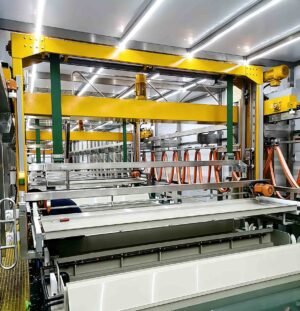
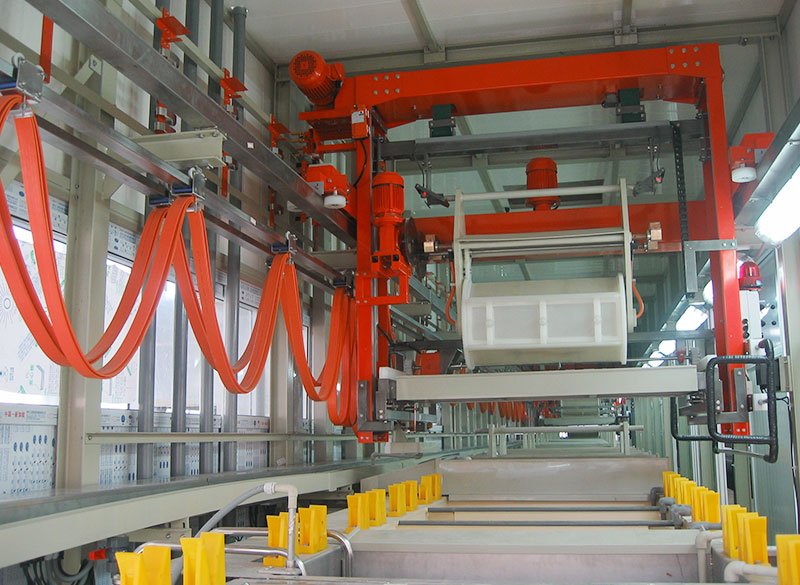
Have you ever walked past an electroplating line and wondered about the purpose of all those different tanks? For newcomers, the variety of chemical baths can be confusing.
To help you understand, we’ve broken down the most common tanks found in a typical electroplating line, explaining what they are and why each one is essential for achieving a high-quality, durable finish.
Overview of the Electroplating Line
A standard electroplating line for plastics follows a logical sequence: Pretreatment → Electroless Plating → Electroplating → Post-treatment. Each tank plays a specific role in preparing the surface, building the conductive layer, depositing the final metal coatings, and ensuring cleanliness.
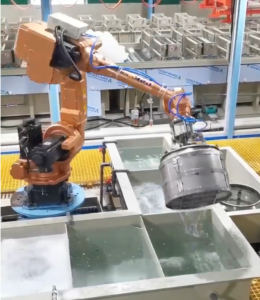
1. Hot Cleaning Tank (Degreasing Tank)
- Main Components: Alkaline degreaser.
- Function: Removes oils, grease, and other contaminants from the substrate surface. This is the essential first step to ensure all subsequent solutions can make uniform contact with the material.
2. Etching Tank (Roughening Tank)
- Main Components: Sulfuric acid, Chromic acid.
- Function: This is a critical step for plastic plating. It microscopically etches the plastic surface, creating tiny pores. This “tooth” provides the physical foundation for superior coating adhesion, preventing failures like peeling or flaking.
3. Sensitizing Tank
- Main Components: Stannous chloride, Hydrochloric acid.
- Function: Deposits a layer of reducing ions (like Sn²⁺) onto the activated surface. This prepares the part for the next catalytic “activation” step, helping to minimize issues like skip-plating or poor coverage.
4. Activation Tank (Accelerator Tank)
- Main Components: Sulfuric acid or proprietary accelerators.
- Function: Removes the outer layer from the sensitized surface, exposing the active catalytic palladium (Pd) nuclei. These nuclei are the “seeds” upon which the first metal layer will autocatalytically deposit.
5. Electroless Nickel Tank
- Main Components: Sodium hypophosphite, Nickel salts.
- Function: Through an autocatalytic chemical reaction, a thin, uniform layer of nickel-phosphorus alloy is deposited onto the catalytically active surface. This step is vital as it creates a conductive metallic layer on the non-conductive plastic, enabling subsequent electroplating.
6. Pyrophosphate Copper Tank (Strike Copper)
- Main Components: Copper pyrophosphate, Potassium pyrophosphate, Ammonia.
- Function: Deposits a thin, adherent, and ductile copper layer. This mildly alkaline bath provides an excellent bonding layer between the electroless nickel and the more aggressive acid copper bath, improving overall adhesion and ductility.
7. Acid Copper Tank (Sulfate Copper)
- Main Components: Copper sulfate, Sulfuric acid, Chloride ions.
- Function: This highly efficient bath rapidly builds copper thickness. It offers excellent leveling capability, smoothing out minor surface imperfections and creating a thick, uniform base for the final decorative layers.
8. Bright Nickel Tank
- Main Components: Nickel sulfate, Nickel chloride, Boric acid, Brighteners.
- Function: Deposits a bright, smooth, and highly corrosion-resistant nickel layer. This is the key decorative and protective layer; its brilliance and leveling directly determine the final part’s appearance and durability.
9. Chrome Plating Tank
- Main Components: Chromic acid, Sulfuric acid catalyst.
- Function: Deposits an ultra-thin top layer of chromium. It provides the signature silvery bright finish, high hardness, and superior wear resistance. (Note: While Hexavalent Chrome (CrVI) is listed, modern lines increasingly use more environmentally friendly Trivalent Chrome (CrIII) processes).
10. Rinsing Tanks (The Most Numerous Tanks)
- Water Types: City water, Deionized (DI) water, Reverse Osmosis (RO) water.
- Function: Positioned after almost every process tank, rinsing is crucial for quality and efficiency. It removes chemical drag-out, prevents cross-contamination between baths, conserves chemicals, and ensures a clean final product.
How Process Failures Relate to Each Tank
| Problem / Defect | Primary Related Tank(s) | Root Cause |
|---|---|---|
| Poor Adhesion | Etching Tank (Most Critical) | Insufficient surface micro-roughness, preventing mechanical “anchoring” of the coating. |
| Skip Plating / Poor Coverage | Sensitizing, Activation, Electroless Nickel Tanks | Incomplete or uneven catalytic activation, leading to areas where plating cannot initiate. |
| Pitting | Multiple Tanks (Etching, Electroless, Electrolytic) | Contamination, poor rinsing, organic/oily residues, or impurities in the bath causing localized non-deposition. |
| Burning (Dark/Rough Deposits) | Acid Copper, Bright Nickel Tanks | Excessive current density, low concentration of main salts, inadequate agitation, or low bath temperature. |
| White Haze / Cloudy Chrome | Chrome Plating Tank | Imbalanced ratio of chromic acid to catalyst (sulfate), incorrect temperature, or improper current density. |
Why Choose a Professional Electroplating Partner?
A flawless plated finish depends on precise control over every single one of these tanks—from chemical composition and temperature to timing and filtration. Understanding this complex chain highlights the expertise required for consistent, high-quality results.
Looking for a reliable partner for your plating projects? Our team masters every step of this process, ensuring durability, aesthetics, and performance. We also prioritize environmental responsibility by adopting advanced technologies like Trivalent Chrome plating.
Contact us today to discuss how we can bring superior quality and finish to your components.